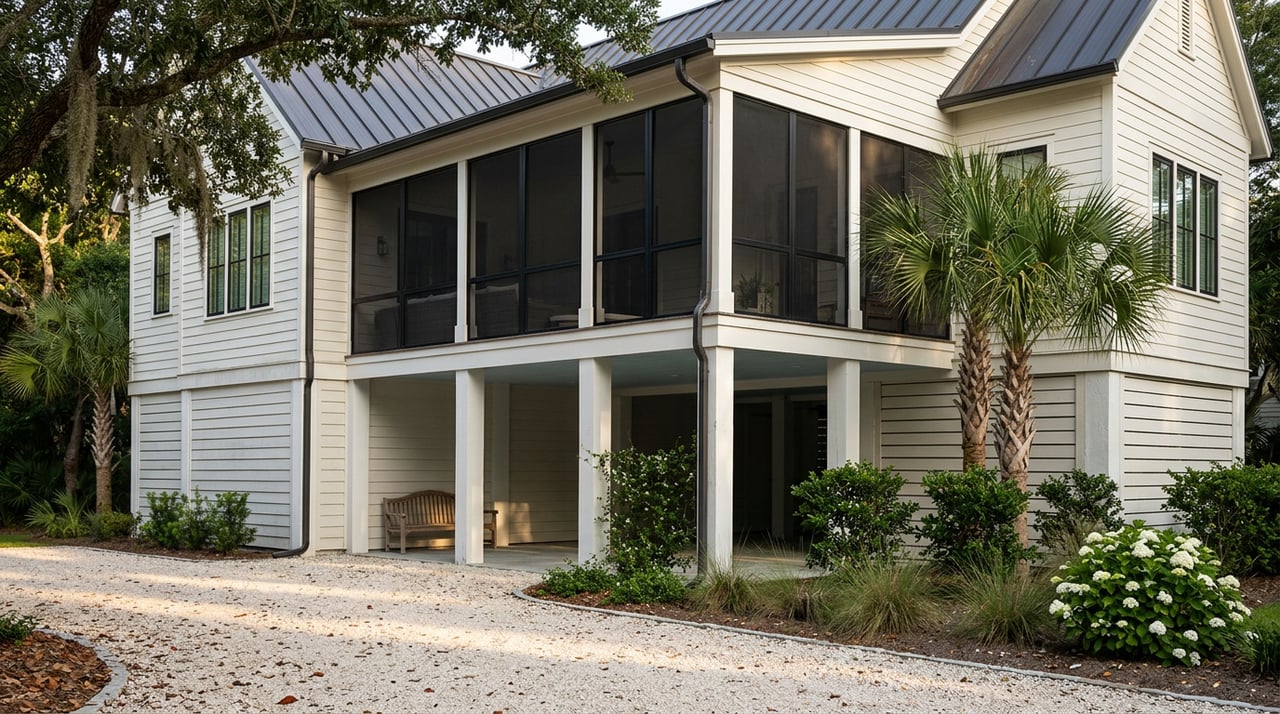
The Isle of Palms Price Gap Most Buyers Miss
August 6, 2026
August 6, 2026
Two houses on adjacent streets, similar square footage, similar finishes, similar views. One trades at a premium the buyer struggles to justify from the photos. The other sits. The gap is rarely about the house. It is about what the house is legally allowed to become the day after closing.
On Isle of Palms, the price you pay embeds an option the neighboring markets have already taken off the table: the transferable ability to operate the property as a fully licensed short-term rental under a framework with no cap on investor licenses. That option is worth something in dollars, and it is priced into the sale even when nobody at the table is saying so out loud. Understanding that mechanism is the difference between reading the median and reading the market.
South Carolina taxes owner-occupied primary residences at 4% of fair market value and non-primary residences at 6%, under SC Code 12-43-220. On a home in the $1.4M range, that ratio alone reshapes the annual carrying cost before a single guest books a night. Add IOP's short-term rental business license, which starts at $450 for the first $2,000 of gross rental income and scales at $4.60 per additional $1,000, and the accommodations tax stack that lands near 14% once state sales tax, state accommodations tax, county tax, and the 1% Isle of Palms Beach Preservation Fee are combined.
None of that is exotic. What is exotic is that Isle of Palms still lets investor buyers into this framework at all, on essentially open terms.
The Nov. 2023 referendum on a 1,600-license cap for non-owner-occupied short-term rentals was defeated by 54% of Isle of Palms voters after a petition drive that had already collected signatures from more than 30% of registered voters, per Post and Courier reporting. The island kept its uncapped investor path. Its neighbors, one after another, did not.
| Market | Investor STR path | Practical status |
|---|---|---|
| Isle of Palms | Business license, no investor cap | Open |
| Sullivan's Island | Prohibited | Hard stop, active enforcement |
| Mount Pleasant | 400-permit cap | Effectively closed to new applicants |
| Folly Beach | 800-permit cap | Rationed |
| City of Charleston | Category 3 off-peninsula | Owner occupancy generally required, 72 to 144 rental days |
Read that column right to left and the Isle of Palms premium starts to make sense. When Sullivan's Island removed the strategy entirely and Mount Pleasant closed its permit window in practice, the demand that used to spread across the region concentrated on the one barrier island that kept the door open.
Portal medians on Isle of Palms move around because they are averaging two overlapping markets. A snapshot of active listings in early Aug. 2026 put the median list price near $1.4M with roughly 9 active homes on the low-turnover side. Redfin, looking at closed sales in Oct. 2025, showed a median sale price of $1.9M and 126 days on market. The Zillow ZHVI in May 2026 sat at $1,509,444, up 1.3% year over year. Historic homes ran a median around $1.1M in 2026, from $850K Wild Dunes cottages to $2M-plus oceanfront estates.
Those numbers are not contradicting each other. They are describing different buyers.
One buyer is competing for a primary residence taxed at 4%, holding for lifestyle, and comparing IOP to Old Village Mount Pleasant at roughly $1.2M without direct beach access, or Sullivan's Island historic stock at roughly $1.4M with tighter inventory. That buyer's math is straightforward.
The other buyer is underwriting a 6% assessment, a 14% tax remit, professional management at 20% to 30% of gross rental income, and nightly rates that range from $250 to well over $1,000 for premium oceanfront. That buyer is paying for the license as much as the house. When the licensability question is clean, the price reflects it. When there is any doubt, the price sits and the days on market climb.
The transaction detail most buyers underestimate is how many independent parties have to agree that the property can actually operate the way the pro forma assumes. The city license is only the first layer.
That is a longer list than most buyers expect, and it is the reason offers sometimes come in strong and then unwind between contract and closing. The friction is procedural, not adversarial, but it is real.
Palm Boulevard, the 21st through 41st Avenue corridor, and Wild Dunes have traditionally been the strongest rental streets on the island. That does not mean every unit inside those areas is eligible. Wild Dunes regimes and individual HOAs may impose rental-frequency limits, minimum-stay requirements, signage rules, or guest-behavior standards stricter than the city. In a few residential-only pockets, they can shut the strategy off entirely regardless of city license.
The Isle of Palms Design Review Board also matters for buyers looking at older homes with renovation ambitions. Exterior changes, additions, second stories, and significant expansions require approval, which can run three to six months. Properties near the IOP Marina in the historic zone face additional scrutiny. Any renovation-driven investment thesis needs that timeline in the pro forma before an offer, not after.
The right question on Isle of Palms is not "what did the last comparable house sell for." It is "what was that comparable house allowed to do, and is my target house allowed to do the same thing." If the answer is yes, the pricing usually rhymes. If the answer is no, the median is a mirage and the comp is not really a comp.
For sellers, the mirror image is true. A clean, active license, a documented rental history, and a regime letter confirming eligibility are marketing assets, not paperwork. They convert the abstract question of what the property could become into a specific answer a buyer can underwrite. Priced and disclosed correctly, that certainty is what unlocks the top of the range.
Can a short-term rental license be transferred to a new owner? No. The city issues licenses to the owner of record, and a buyer needs to apply after closing. Building that into the contract timeline avoids a gap between deed transfer and first legal booking.
Does IOP restrict rentals of 30 days or more? The short-term rental framework applies to stays under 30 consecutive days. Longer stays fall under different rules and different tax treatment, and are a separate conversation.
How much does the 4% versus 6% assessment actually change annual taxes? The gap runs meaningfully into thousands of dollars per year on IOP price points and compounds over a hold period, which is why the primary-residence versus investor question belongs in the underwriting before an offer, not after.
If you are weighing Isle of Palms against Sullivan's Island, Mount Pleasant, or a Wild Dunes regime property and want the licensability question answered before you write the offer rather than after, Ellen O'Neil Properties will walk the specific address, the specific regime, and the specific numbers with you. Let's Connect.
Stay up to date on the latest real estate trends.
Strategic marketing, trusted guidance, and a client-first approach designed to deliver exceptional results.