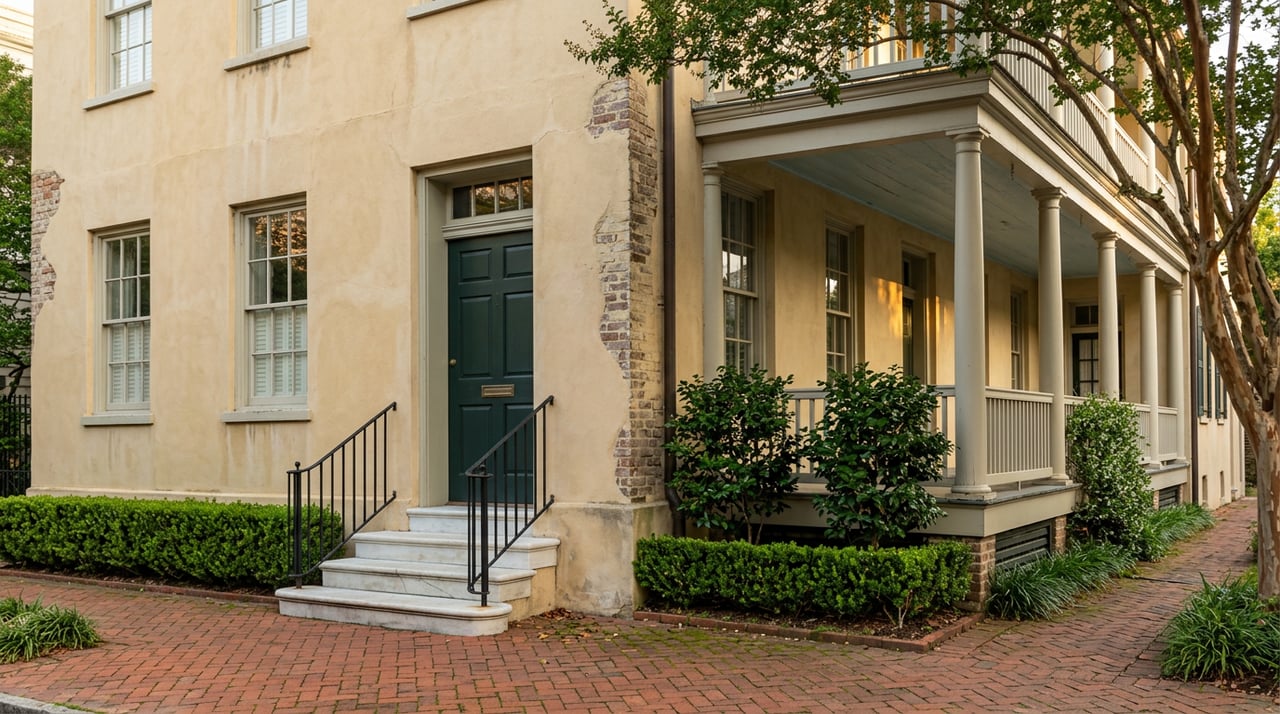
The Three Deadlines That Decide Your Historic Charleston Closing
August 20, 2026
August 20, 2026
Why do two nearly identical Charleston Singles, both under contract the same week, end up on completely different timelines? One closes on schedule. The other slips past its date twice, and not because anything is wrong with the house. What usually derails a historic-district purchase on the peninsula is a paperwork sequence: three separate approvals, each running on its own clock, each one wrecked by being started too early or finished too late.
Most guides to buying an older Charleston home read like a single flat checklist. Get the termite letter. Check the flood zone. Plan for the historic review board. Treated that way, the three sound interchangeable, like items you can knock out in whatever order is convenient. They are not interchangeable. Each one has a deadline that runs in a different direction, and getting even one of them backward can push a closing date that everyone assumed was settled.
Here is the reframe worth carrying into any offer on a peninsula property. You are not managing one closing timeline. You are managing three, and they pull against each other.
| Requirement | Earliest you can reasonably start it | When it must be current or complete | What goes wrong with bad timing |
|---|---|---|---|
| CL-100 Wood Infestation Report | Close to your closing date, not the week you go under contract | Must be dated within 30 days of closing | Order it too early and it can expire before the sale finishes, forcing a second inspection |
| NFIP flood insurance | As soon as you have a firm address | Bound at least 30 days before coverage needs to be active | Wait until closing week and coverage may not be in force on moving day |
| BAR Certificate of Appropriateness | Concept review can begin while you're still under contract | Full process typically runs 2 to 6 months for major exterior work | Wait until after closing and a spring project can slide into fall |
The pattern is the point. The termite report has a "don't start too early" clock. Flood coverage has a "don't start too late" clock. The historic review process has a "start before you even own it" clock. A buyer who optimizes for one of these without checking the others is the buyer whose closing gets pushed.
In South Carolina, the document everyone calls the termite letter is formally the CL-100 Wood Infestation Report, and it is regulated by Clemson University's Department of Pesticide Regulation under state code. The inspection itself is inexpensive, typically $75 to $150, and a licensed pest control operator checks visible, accessible areas for active or past termite activity, other wood-destroying insects, and wood decay fungi, which shows up often in Charleston's humid crawl spaces.
The requirement that catches buyers off guard is the 30-day window. A CL-100 has to be dated within 30 days of closing to be treated as current. Order it the week you go under contract on a peninsula home, and by the time attorneys, surveys, and a full due diligence period run their course, that report can age out before you ever reach the table. Most lenders, including FHA and VA programs, will not fund without a clear report, and the standard South Carolina purchase contract typically makes the sale contingent on one. If the report comes back with findings, the seller is usually expected to remedy the issue and furnish an updated CL-100 before closing, or the buyer negotiates a credit or price adjustment.
Given Charleston's exposure to both native subterranean termites and Formosan termites, which thrive in the warm, coastal climate, many owners also carry a termite bond on top of the one-time letter. Setup typically runs $500 to $2,000 depending on the property, with annual renewals in the $150 to $400 range. Against a peninsula purchase price, that is a rounding error. The delay from ordering the CL-100 at the wrong point in the timeline is the part that actually costs money.
The City of Charleston states plainly that every property within city limits sits in some flood zone. Not every property falls inside FEMA's Special Flood Hazard Area, the zones labeled AE, Coastal A, or VE, but properties in the lower-risk X zone are still within a flood zone as the city defines it. That distinction matters because a standard homeowners policy does not cover flood damage under any circumstances. Flood coverage is a separate product, arranged through the National Flood Insurance Program or a private carrier.
The number that should change how a buyer schedules things is this: NFIP policies generally carry a 30-day waiting period before coverage takes effect. Bind a policy the week before your closing and you may own the home for most of a month with no flood coverage active, regardless of what the mortgage paperwork says. The city's own flood information data also notes that roughly a quarter of flood insurance claims come from properties in the lower-risk, low-to-moderate designation, which is a useful corrective for any buyer tempted to treat an X zone as a reason to skip the conversation entirely. You can check a specific address against FEMA's official flood maps through the FEMA Flood Map Service Center before you ever make an offer, and it is worth doing early enough that a 30-day wait doesn't become a surprise on move-in day.
If the plan includes any exterior work, and on the peninsula it usually does, the clock that matters most is the one tied to Charleston's Board of Architectural Review, the BAR. Established in 1931 as the country's first local preservation ordinance, the BAR reviews changes visible from the public right of way: windows and doors, porches and stairs, roof materials and pitch, shutters and balconies, siding and masonry treatment, and most additions or demolitions. Interior work generally falls outside its jurisdiction unless the property carries a preservation easement, often held by an organization like the Historic Charleston Foundation, that extends protection to interior features as well.
A Certificate of Appropriateness has to be issued before a building permit can move forward, and the realistic math is sobering for anyone assuming renovation starts the week after closing. Concept review commonly takes 2 to 6 weeks, final approval adds another 2 to 8 weeks, and permitting can run 4 to 12 weeks on top of that. Add it up and major exterior projects routinely need 2 to 6 months of lead time before a contractor picks up a hammer. Smaller, more visible items go before the full board, which meets on a fixed schedule with capped agendas, currently 8 items for large projects and 15 for small ones. Straightforward, in-kind repairs can sometimes clear at the staff level, which moves faster, but even staff review takes real time to schedule and revise.
An early 2026 BAR case at 280 Meeting Street shows what this looks like in practice. The adaptive reuse proposal drew public comment supporting a plan to restore the building's mid-century front elevation and add a third-floor addition, with at least one commenter asking the board to push that addition further back from the street. That kind of back-and-forth is normal, and it's also why these projects take multiple review cycles to finalize. The city also introduced a newer opt-in review option for the Historic Materials Demolition District north of Line Street in a BAR University session earlier this year, a reminder that the rules governing what you can and cannot alter keep evolving even after you've studied them once.
None of this is complicated once you see it as sequencing rather than a checklist.
None of these three items is expensive on its own. A CL-100 runs under $150. A termite bond might run a few hundred dollars a year. Flood insurance and homeowners coverage are ordinary carrying costs. What makes the sequencing worth getting right is the price tier these decisions attach to. The broader Charleston-area median sale price was $625,000 as of July 2026, but that figure describes the whole metro, not the historic peninsula. In South of Broad specifically, the median runs between $2.9 million and $3.5 million as of May 2026, with price per square foot frequently exceeding $1,050.
At that price point, a closing delay is not a paperwork inconvenience. It can mean an extended rate lock fee, a lapsed contingency that has to be renegotiated, or a seller who starts fielding backup offers while your CL-100 expires on the shelf. The three-clock problem is not about the cost of any single form. It is about what a missed deadline does to a transaction where the numbers are this large.
Does BAR review apply to interior renovations? Generally no. The board's jurisdiction covers what is visible from the street. Interior changes only come under review if the property is a designated landmark or carries a preservation easement that specifically extends to interior features.
Can a cash buyer skip the CL-100 entirely? South Carolina law does not mandate a CL-100 for every single sale, but most standard purchase contracts and virtually every mortgage lender require one regardless of financing type. A cash buyer can technically waive it, though given how active both subterranean and Formosan termites are along the coast, skipping it is a real risk rather than a shortcut.
If my property is in an X zone, do I still need to think about flood coverage? Worth thinking about, yes. The city's own data shows a meaningful share of claims come from properties in lower-risk zones, and a standard homeowners policy will not step in if water does.
Buying an older home on the Charleston peninsula rewards patience with paperwork almost as much as it rewards good taste in porches. If you're weighing a historic purchase and want help sequencing the approvals, the inspections, and the insurance so nothing catches you off guard at the closing table, Ellen O'Neil Properties is glad to walk through the timeline with you before you ever write an offer. Let's Connect.
Stay up to date on the latest real estate trends.


Newsletter
Your Monthly Charleston Updates!
Strategic marketing, trusted guidance, and a client-first approach designed to deliver exceptional results.