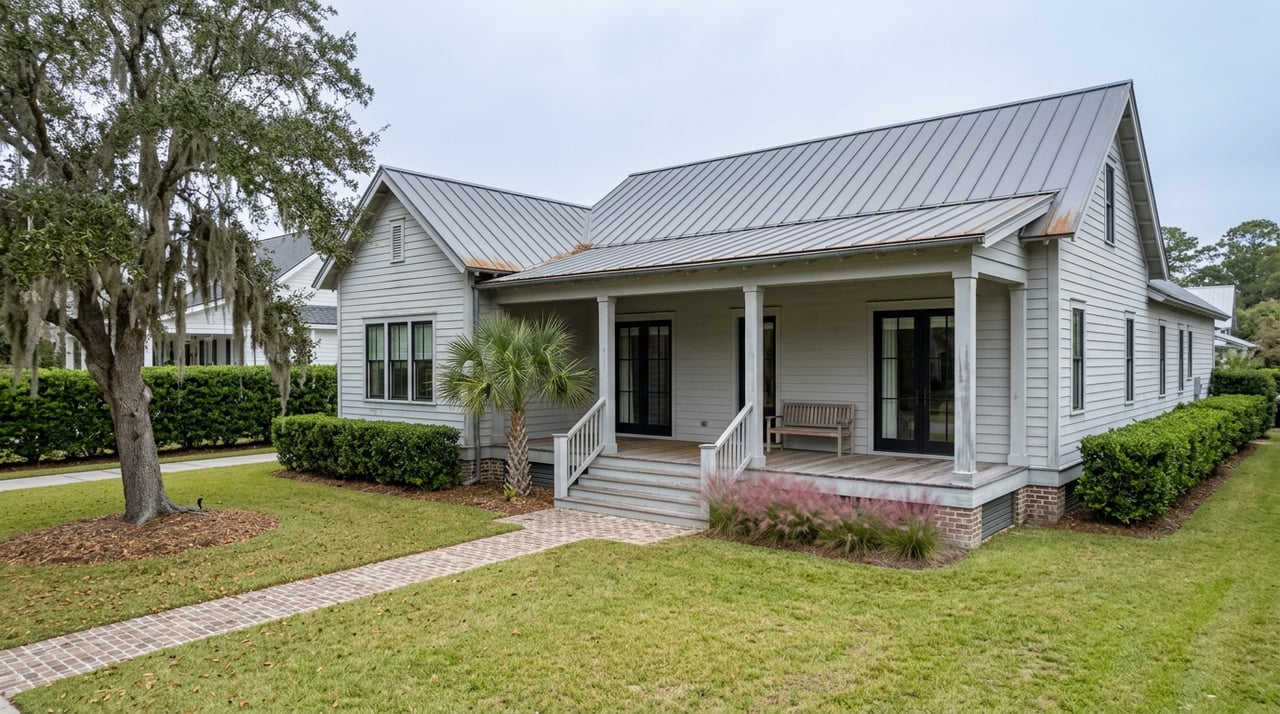
The Mount Pleasant Slowdown Everyone's Reading About Isn't the One You'll Feel
September 24, 2026
September 24, 2026
A buyer watching Mount Pleasant listings this summer did everything right. She read the headlines about a cooling market, saw days on market climbing and price reductions spreading across the portals, and decided to wait out a $780,000 four-bedroom in Park West rather than compete for it. Three weeks later it was under contract, over list, with two backup offers still in line.
She wasn't wrong about the data. She was reading the wrong bracket of it.
Mount Pleasant's 2026 housing market is genuinely softening in places. It is also, in the exact price range where most buyers are actually shopping, still moving close to full speed. Both things are true in the same town at the same time, and local limits on new residential permits help explain how the two conditions can coexist.
Start with the numbers driving the "buyer's market" headlines. Earlier in 2026, sale-to-list ratios in Mount Pleasant sat at 97.47 percent, only 10 percent of homes sold above asking (down from 13.16 percent the year before), and homes with price reductions rose from roughly two-thirds of listings to three-quarters. Those figures are real, and they're the basis for most of what you'll read about Mount Pleasant this year.
But break the market apart by bracket and a different picture appears. Old Village listings have been averaging somewhere between 85 and 118 days on market across current MLS inventory, with a median list price in the $3.17 million to $3.52 million range. I'On's median sale price ran $2.2 million in May 2026, with homes there averaging 126 days on market. That's where the slowdown actually lives: the top of the market, where fewer buyers can transact and each one negotiates harder.
Below $900,000, the story flips. Snee Farm's median sale price was $849,714 in May 2026, Carolina Park's was $974,672, and both continued to see multiple offers on well-priced, move-in-ready homes. Redfin's own trailing three-month data through August 2026 shows Mount Pleasant homes selling after 64 days on market, up only slightly from 61 days a year earlier, with 595 homes sold in August 2026 versus 528 the year before. Sales volume went up, not down.
| Bracket | Example neighborhoods | 2026 price signal | What it means for a buyer |
|---|---|---|---|
| Under $900K, detached | Snee Farm, Carolina Park, interior Dunes West | Median in the $850K-$975K range, multiple offers common | Price at or near list; this isn't the bracket where waiting pays off |
| $2M and above | Old Village, I'On | 85-126 days on market, wide list-to-sale gaps | Room to negotiate credits, repairs, and closing costs |
| Attached product, 60+ days on market | Townhomes and condos, $400K-$650K entry point | Reductions cluster in aged listings | Sort by days on market before assuming the whole segment is soft |
The town-wide median hides all three rows and shows you an average of conditions nobody is actually buying into.
The permit allocation system helps explain why softening at the top of the market has not spread down into the bracket where most people are shopping.
The town first adopted a Building Permit Allocation System in January 2019, limiting how many new residential permits could be issued town-wide. The Post and Courier reported that, in December 2023, Town Council voted to extend it for another five years, through 2029. Under the current rules, the town allows roughly 2,400 single-family permits and 500 multi-family permits over the five-year cycle, and the Town of Mount Pleasant's Building Permit Allocation System page says no more than 25 permits go to any single development in one allocation period.
The town council's stated reasoning, laid out in the ordinance itself, points to school capacity and road congestion as the drivers behind slowing the pace of new construction. Whatever you think of the policy, its market effect is straightforward: no matter how much a $2 million listing in Old Village might soften, the total number of new homes the town allows each year is fixed by code, not by demand. That ceiling is why a broad, town-wide price correction is structurally harder here than in a market with open land and no permit cap.
There's one carve-out in the ordinance worth knowing if new construction is part of your search. Carolina Park and Liberty Hill Farm are excluded from the Building Permit Allocation System entirely, under development agreements that predate the ordinance. That's the reason Carolina Park has kept delivering new inventory even while permits everywhere else in town are metered out in batches of 25.
That runway is shortening, though. As of a July 2026 neighborhood comparison, Carolina Park's developer had reported that the last new custom home lot in its Riverside section had already sold, while final homes in the Preserve section were still under construction. If you want a genuinely new-build option inside Mount Pleasant's town limits, rather than a resale, Carolina Park and Liberty Hill Farm are effectively your only paths, and even they won't stay open indefinitely.
Part of what makes comparing Mount Pleasant to Daniel Island, Wando, or any other neighborhood confusing is that the word "median" doesn't mean the same thing from one site to the next.
Redfin's $915,000 figure covers the three months ending August 2026 and reflects closed sales, actual transactions that went through the MLS. Zillow's headline number, by contrast, isn't a transaction median at all. It's the Zillow Home Value Index, an estimate built from modeled property values across the town's housing stock, which stood at $767,550 as of its most recent update, up 4.3 percent over the past year. Houzeo cites a median home price of $855,000, up 1.12 percent year over year, pulled from its own read of MLS data. None of these numbers is wrong. They're answering different questions: what actually sold, what a model estimates the typical home is worth, and what's currently priced to sell. Stack any two of them side by side without knowing which is which, and you'll draw the wrong conclusion about whether a neighborhood is expensive or affordable relative to another.
A few things worth checking before you write an offer or rule a neighborhood out:
Financing conditions matter here too. The 30-year fixed rate averaged 6.95 percent as of September 17, 2026, according to Freddie Mac's weekly survey, up from 6.76 percent the week before. For a buyer in the sub-$900,000 bracket, that rate movement changes your monthly payment more than a few extra days on market ever will. It's a reason to get pre-approved and know your number before you start comparing neighborhoods, rather than after.
Will Mount Pleasant's permit cap end before 2029? Not under the current ordinance. Town Council extended it for a full five-year term in the December 2023 vote. There's no proposal on record to end it early.
Does the cap mean prices can never come down? No. It limits how fast new supply can respond to demand, not what any individual buyer is willing to pay. The luxury bracket above $2 million is proof that individual listings can sit and soften even while the town's overall permit ceiling stays fixed. The cap shapes how far a slowdown can travel across the market, not whether one can happen at all.
If you're trying to figure out which Mount Pleasant bracket your budget actually lands in, or how it stacks up against Daniel Island, Wando, or another Charleston-area community you're weighing, that's exactly the kind of comparison worth walking through with someone who watches these numbers by neighborhood, not just by town. Ellen O'Neil Properties works across Mount Pleasant and the surrounding Lowcountry every day. Let's Connect.
This article is general information, not legal, tax or financial advice. Consult a qualified professional about your situation.
Stay up to date on the latest real estate trends.
StoryBook


Strategic marketing, trusted guidance, and a client-first approach designed to deliver exceptional results.